





History and new perspectives on topdressing
Topdressing — the practice of applying sand or soil to turf surfaces — has its roots in early golf course management and has evolved into a precise, science-based practice. It is often credited to Old Tom Morris, who discovered its benefits accidentally at St Andrews Links in Scotland in the 19th century. Early methods were labor-intensive, relying on wheelbarrows and shovels and their application was uneven.
In the early 20th century, researchers such as Charles Piper, Ph.D., and Russell Oakley, Ph.D., formalized topdressing recommendations, promoting the application of sand to improve clay soils and protect turf. The USGA Green Section later advanced the idea of lighter, more frequent applications. Materials varied widely, typically including sand mixed with soil and organic matter.
Topdressing declined during the 1930s–1940s due to World War II, sand shortages and the rise of mechanical aerification. However, the practice was revitalized in the late 1950s through research by John Madison, Ph.D., who demonstrated the advantages of sand-only topdressing. His work, combined with the development of mechanized topdressers in the 1960s, made frequent applications practical and led to widespread adoption by the 1970s.
Debate persisted into the 1990s over sand-only versus mixed materials, but sand prevailed due to its consistency, resistance to compaction and role in controlling thatch. Today, topdressing is a routine practice on golf greens with light, frequent sand applications made weekly using modern, highly efficient equipment.
Modern sand topdressing
Modern sand topdressing programs are designed to improve both turf health and playing quality on golf course putting greens. Key benefits include creating a smooth, firm surface, increasing shoot density, reducing thatch accumulation, protecting against winter injury and enhancing the movement of air, water, nutrients and roots through the soil. Topdressing also promotes healthier crowns in annual bluegrass and can reduce disease severity, particularly anthracnose, under stressful conditions.
Successful programs depend on several factors, including material selection, timing, frequency, rate and application method. Light, frequent applications — often less than 0.018 yd3 per 1000 ft2 (0.15 L·m⁻²) every seven to 14 days — are commonly used during the growing season to maintain playability while minimizing disruption. Heavier applications are typically reserved for spring and fall, often combined with cultivation practices. Achieving the correct annual sand total is critical, as insufficient applications may fail to deliver benefits, while excessive rates can interfere with turf performance.
Modern challenges include managing dense turf canopies, low mowing heights and selecting appropriate sand materials. Sands should match the underlying root zone and meet USGA specifications. While finer sands may aid incorporation, their long-term effects require further research. Overall, consistent, well-designed topdressing programs are essential for maintaining the quality of putting surfaces.
Sand topdressing for thatch management
Sand topdressing plays a significant role in managing thatch in turfgrass systems. Thatch, defined by James Beard, Ph.D., as a layer of living and dead plant material between green vegetation and the soil, can be beneficial in moderation by improving surface resiliency, wear tolerance and temperature buffering. However, excessive thatch creates serious problems, including poor water movement, hydrophobicity during dry periods and waterlogging during wet conditions. It also restricts root growth, elevates crowns and increases susceptibility to drought, heat stress, scalping, pests and diseases.
The buildup of organic matter results from turf growth, over-fertilization, too much water and inadequate soil cultivation. While soil organic matter has environmental benefits such as nutrient storage and carbon sequestration, it can cause negative physical effects in turf systems when excessive. The thickness or organic matter content is a common way to measure thatch, but results may vary depending on the method used.
Research shows mixed results on topdressing’s role in thatch control. Some studies indicate that topdressing primarily dilutes thatch by forming a “mat” layer (sand plus organic matter), while others suggest it also enhances decomposition. Applying sand more often or at higher rates has been found to decrease both organic matter and thatch thickness, although this effect does not occur in all situations.
Effective programs match sand application rates and frequency to the rate of thatch accumulation. Light, frequent topdressing minimizes layering and disruption to play. There are some recommended annual sand rates for topdressing and aerification of 1.46–1.82 yd³ per 1,000 ft² (12–15 L·m⁻²) to keep organic matter within limits and maintain healthy, high-quality putting surfaces.
Case study on annual bluegrass
This three-year field study evaluated the effects of sand topdressing on organic matter accumulation and turf performance in a monostand of annual bluegrass putting green in New Jersey. Treatments consisted of varying sand application rates in autumn, spring, and summer, resulting in cumulative totals ranging from 0 to 2.2 yd3 per 1000ft2 (0 to 18 L·m⁻²) over the study period.
This three-year field study was a 3 × 3 × 3 factorial of autumn, spring and summer topdressing in a randomized complete block design with four replications. Autumn and spring topdressing were applied each year at 0, 0.146, 0.3 yd3 per 1000 ft2 (0, 1.2, or 2.4 L·m–2), and 0, 0.073, or 0.146 yd3 per 1000 ft2 (0, 0.6, or 1.2 L·m–2) of sand was applied during summer.
Core cultivation was not applied during the study. Each of the 27 treatment combinations from the 3 × 3 × 3 factorial design was applied to the same plot location, generating a range of topdressing sand quantities from 0 to 2.2 yd3 per 1000 ft2 (0 to 18 L·m–2) over three growing seasons.
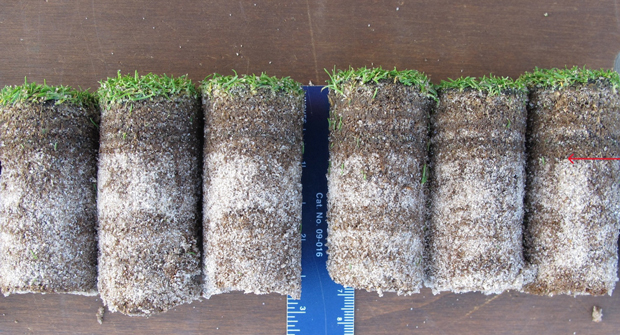
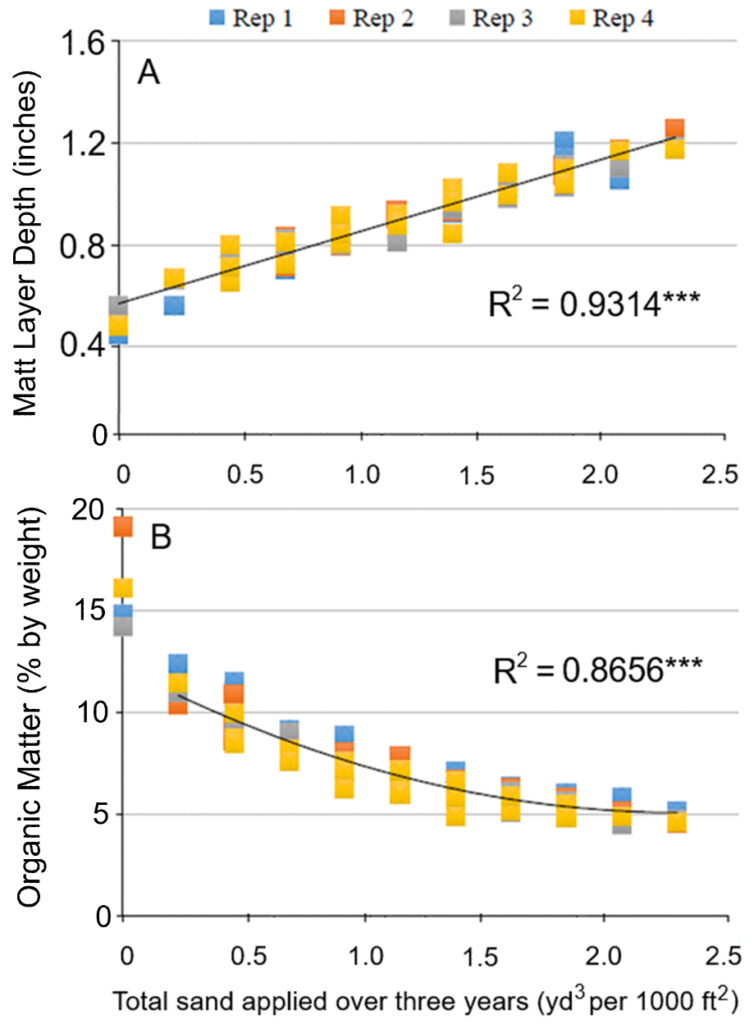
Results showed that sand topdressing significantly influenced both mat layer development and organic matter dynamics (Figure 1). A distinct mat layer, composed of sand intermixed with organic material, developed across treatments, with depths ranging from 0.43 to 1.22 inches (11 to 31 mm) (Figure 2A).
Increasing topdressing rates led to a linear increase in mat layer depth, while organic matter content declined as sand rates increased, following a quadratic response (Figure 2B). The highest sand rates produced the lowest organic matter content, although reductions became less pronounced at higher application levels, suggesting diminishing returns.
This study confirmed that topdressing reduces organic matter concentration primarily through dilution rather than enhanced decomposition. There was little evidence that sand applications accelerated microbial breakdown of thatch.
In some cases, increased topdressing even promoted turf growth, leading to greater biomass production and organic matter accumulation per unit area. Seasonal influences were also noted: Applying treatments in spring and summer promoted greater accumulation of organic matter during vigorous turf growth, whereas autumn applications had an insignificant effect.
Topdressing improved rootzone physical properties by reducing surface water retention and enhancing soil structure, but inconsistent or high single-season applications led to undesirable layering, which can restrict water infiltration and root growth.
Overall, the study demonstrates that sand topdressing is essential for managing organic matter on annual bluegrass greens, primarily by diluting thatch and building a functional mat layer. However, optimal programs must balance application rate, timing and frequency to avoid layering and diminishing efficiency, while aligning with turf growth patterns and local environmental conditions.
Research takeaways:
- Sand topdressing remains essential for managing putting green performance.
- Organic matter has value that supports soil health, nutrient cycling and carbon sequestration.
- Excess concern over organic matter buildup may be overstated.
- When carefully planned, topdressing can store organic material in the rootzone, creating good growth media for turfgrass.
- Avoid single-metric decisions because the percentage of organic matter alone is not a dependable management guide.
- Evaluate the entire system, which includes root health and depth, soil layering, water infiltration, surface firmness and playability.
- Move from threshold-based to systems-based management.
Adapted from: Wang R, Hempfling JW, Murphy JA. 2025. Sand topdressing: the history, current knowledge, and new perspectives of its role in organic matter management. Grass Research 5: e003 https://doi.org/10.48130/grares–0024–0028
The original research was conducted at Rutgers University. Here are the current affiliations of the authors: Ruying Wang, Ph.D., Michigan State University; James W. Hempfling, Ph.D., Envu Turf & Ornamentals North America, and James A. Murphy, Ph.D., Rutgers University. For more information, contact Ruying Wang at wangruyi@msu.edu
Subscribe to Golfdom



If you enjoyed this article, subscribe to Golfdom to receive more articles just like it.

About the Author: James Murphy, Ph.D.
James Murphy, Ph.D. is an extension specialist in turfgrass management at Rutgers University.